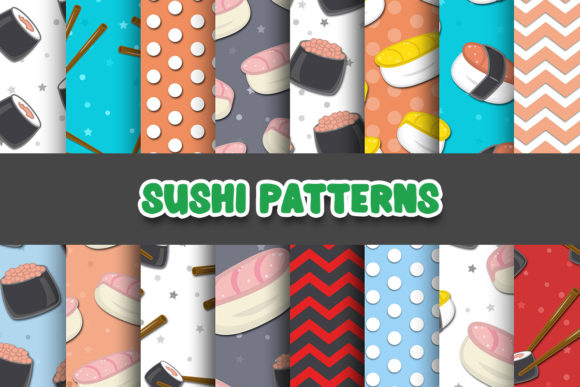
Sushi Digital Papers Patterns
A set of 16 sushi digital papers offers more than just a themed background. For professionals, entrepreneurs, and creators working across invitations, branding, social media, or event planning, these patterns represent a tactical asset that can streamline design decisions and reinforce visual identity. The sushi motif is distinctive without being polarizing, making it useful for a wide range of applications from children's birthday parties to high-end restaurant marketing materials. The key is not to use them as a quick fill, but to integrate them deliberately into a broader communication strategy.
Why Digital Patterns Matter for Brand Consistency and Visual Communication
Patterns often receive less attention than primary logos or hero images, but they carry significant weight in establishing a cohesive look. When you apply a set like Sushi Digital Papers Patterns across multiple touchpoints—invitations, website backgrounds, product packaging, or email headers—you create a subtle thread that ties the audience’s experience together. This repetition builds recognition and trust. For a small business owner running a Japanese-inspired café, using the same sushi pattern on a loyalty card and a takeout menu reinforces the brand’s personality without needing extra explanation. The 16 variations in this collection allow for enough diversity to avoid monotony while preserving a unified theme.
Planning Your Use of Sushi Digital Papers Patterns for Different Projects
Before opening a design tool, think about the project’s primary goal. Are you celebrating a milestone birthday, launching a pop-up event, or creating a scrapbook memory? Each scenario calls for a different level of pattern prominence. For a formal sushi-making workshop invitation, you may want a subtle pattern as an elegant border or watermark, letting the text remain the hero. For a colorful children’s party, a bold repeating sushi pattern can fill the entire background with energy. Planning includes deciding the scale and repetition of the pattern: a large-scale print feels modern and minimal, while a smaller tile creates texture and detail. The 16 papers give you the flexibility to adjust without starting from scratch.
Strategic Considerations When Selecting a Sushi Pattern for Your Campaign
Not every pattern in the set will serve every purpose equally. Evaluate factors like color harmony, density of illustration, and cultural context. A pattern that features nigiri and maki on a clean white background works well for minimalist branding, while a more intricate pattern with chopsticks and soy sauce bottles might suit a recipe blog header or a food truck wrap. Consider your audience’s familiarity with sushi imagery—if you are targeting a general audience, avoid overly detailed patterns that might distract. For a campaign promoting healthy eating, select patterns with fresh ingredients (salmon, avocado, cucumber) rather than deep-fried rolls. This is not about aesthetic preference alone; it is about aligning the pattern with the intended message and audience expectations.
Integrating Sushi Patterns into Workflow for Efficiency and Creativity
Once you have identified the right pattern, integrate it into your production pipeline. Digital papers are typically high-resolution JPEG or PNG files that can be opened in Canva, Photoshop, Illustrator, or even presentation software. Create templates for frequently used formats—social media posts, business card backgrounds, newsletter headers—with the pattern already placed. This saves time in the long run, especially when you work on recurring events like monthly sushi specials or seasonal menus. The 16-paper set gives you a library that can be swapped in and out based on the season or promotion. For example, use a lighter pattern for spring and a richer one for autumn. This systematic rotation maintains freshness without requiring new design work each time.
Risks of Random Application and How to Avoid Misalignment
Using digital patterns without a clear brief can undermine a project. Common pitfalls include overwhelming the content with a busy pattern, mismatching colors that clash with existing brand elements, or applying the same pattern to both print and digital without checking resolution. For print projects, ensure the pattern file is at least 300 DPI to avoid pixelation. For web use, compress the file to keep load times fast. Another risk is cultural insensitivity—using patterns that include sushi elements in a context where sushi is not appropriate, such as a formal business report. To avoid these issues, define the pattern’s role before placement: is it a background, an accent, or a filler? Test it on a small sample with your target audience if possible. Deliberate evaluation prevents the pattern from becoming a distraction.
Long-Term Value of a Curated Set of Digital Papers for Entrepreneurs and Creators
Investing in a themed pattern set like Sushi Digital Papers Patterns pays off over multiple projects. A single set can be repurposed across years—for a birthday party each year, a series of seasonal promotions, or a growing portfolio of scrapbook pages. The consistency also helps you build a personal or brand library that reflects a defined visual language. For an educator creating teaching materials about Japanese cuisine, the 16 papers provide a ready-made aesthetic frame that supports the topic without extra research. For a hobbyist scrapbooker, the themed set reduces decision fatigue: instead of hunting for coordinating paper, you have a coordinated collection at hand. This efficiency is not about cutting corners; it is about freeing cognitive resources for the creative decisions that matter more.
Practical Examples: From Invitation Design to Social Media Templates
Consider a real scenario: a freelance event planner organizing a sushi-making class. Using one of the 16 sushi patterns as a background for the email invitation, the same pattern cropped as a side bar on the event webpage, and a different pattern as a header on the printed thank-you card creates a cohesive but not repetitive look. For a social media campaign, the patterns can serve as frames for photos of the event. Another example: a mom creating a scrapbook for a child’s sushi-themed fifth birthday. She uses a bright pattern with rainbow rolls for the cover, a muted pattern for journaling pages, and a matcha green pattern for pocket inserts. The 16-paper set gives enough variety to tell a story through background transitions.
Decision-Making Framework for Choosing the Right Pattern
To select wisely, follow a simple decision tree. First, clarify the medium: print or digital? Print patterns benefit from higher resolution and less compression. Second, identify the pattern’s function: full background, partial overlay, or accent strip. Third, review the pattern’s dominant colors against your existing palette. If your brand uses pale shades, a high-contrast pattern may dominate too much. Fourth, consider the emotional tone: playful, sophisticated, educational, or festive. The 16 sushi patterns likely cover a spectrum from cute and cartoony to elegant and minimalist. Match the pattern’s character to the project’s mood. Fifth, test readability: place sample text over the pattern and adjust opacity or masking. This structured approach turns a subjective choice into a strategic one.
Sustaining Creativity Through Themed Paper Collections
Having a library of themed papers like this set can be a creative spark in itself. When you feel stuck on a design, browsing through the 16 patterns may suggest a new direction or a new use case. For instance, a pattern that originally seems too busy for an invitation might work beautifully as a wrapping paper or a gift tag. The patterns also encourage experimentation with layering—combine two patterns from the set for a collage effect, or use one as a mask for another. This exploratory play is valuable for both professionals and hobbyists because it lowers the barrier to trying new visual ideas. The patterns become a sandbox for creative risk without a large time investment.
Ultimately, Sushi Digital Papers Patterns are not just decorative elements. When chosen with intention and integrated into a broader strategy—whether for branding, event planning, education, or personal projects—they can enhance consistency, save time, and support the communication goals that matter to you. The 16 papers provide a palette of possibilities, but the real value lies in how you decide to use them. Treat them as a tool in your creative toolkit, not a shortcut, and they will serve you across many projects with enduring relevance.