10 Honey Seamless Patterns for Bold Branding
If you have ever needed a design element that walks the line between natural warmth and modern precision, a set of honey seamless patterns might be exactly what your workflow is missing. I have worked with countless texture packs over the years, and the 10 Honey Seamless Patterns collection stands out because it does not force you to choose between organic charm and clean geometry. It delivers both.
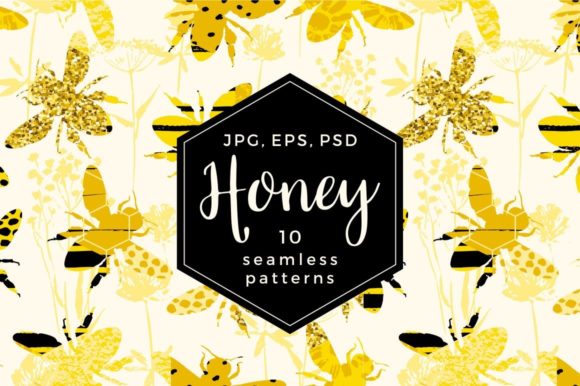
This pack gives you ten distinct seamless patterns built around honeycomb hexagons, bee motifs, and honey-inspired textures. Each pattern comes in three formats—EPS 10, high-resolution JPG at 300 dpi, and layered PSD—which means you can drop them into almost any project without reformatting or scaling issues. Whether you are a freelancer juggling client work, a small business owner building your brand, or a hobbyist experimenting with surface design, this set offers real utility right out of the gate.
What Makes a Seamless Pattern Pack Worth Your Time
Seamless patterns save you from the tedious work of aligning tiles, matching edges, or fixing visible repeats. The 10 Honey Seamless Patterns pack handles that heavy lifting so you can focus on composition, color harmony, and placement. Each file is tile-ready, meaning you can apply it to large surfaces like wallpaper rolls or fabric runs without worrying about awkward seams.
The geometric honeycomb structure is naturally modular. Hexagons tile perfectly, which is why bees use them and why designers keep coming back to them. But this set goes a step further by mixing hand-drawn textures with geometric precision. You get the crisp lines of a hex grid alongside softer, organic strokes that mimic wax, dripping honey, or sketched bee wings. That contrast gives your work a tactile quality that purely vector patterns often lack.
Another strength is the variety across the ten designs. Some patterns lean minimal and modern, with thin lines and subtle repeats. Others are denser, featuring layered hexagons, bee silhouettes, and golden gradients. If you are building a cohesive collection—say, for a product line or a seasonal campaign—you can pull different patterns for different applications while keeping a unified honey theme.
Real-World Applications Across Industries
I have seen design packs gather dust because they look good in previews but fail in production. This set avoids that trap. Here are several practical ways to use it, based on what I have observed working well for professionals and creators.
Branding and identity work. Honey motifs work beautifully for organic food brands, skincare lines, wellness studios, and artisanal product labels. The hand-drawn textures add an artisanal feel that photography sometimes cannot match. You can use one pattern as a background on business cards or social media templates, and another for packaging wraps. Because the files are layered in PSD, adjusting colors to match a brand palette takes minutes.
Fabric and surface design. If you are in textile design or print-on-demand, seamless patterns are non-negotiable. The 300 dpi JPGs print cleanly on fabric, and the EPS files give you vector scalability for large-format printing. I have seen these patterns used on throw pillows, tote bags, phone cases, and even upholstery. The honeycomb geometry looks especially good on structured materials like canvas or linen because the repeat stays crisp.
Digital content and publishing. Bloggers, educators, and content creators often need backgrounds that do not distract from text or graphics. A subtle honey pattern from this set can serve as a backdrop for recipe cards, wellness worksheets, or seasonal social media posts. The lighter patterns work well as website section backgrounds, while the bolder ones can anchor product photography or video title slides.
Interior decor and stationery. This is where the hand-drawn textures really shine. When printed on matte paper, the patterns have a almost tactile depth. I have seen them used for wrapping paper, notebook covers, gift tags, and wall art prints. The hexagonal geometry also fits well in modern minimalist interiors, where organic shapes add warmth without clutter.
Practical Considerations When Choosing a Pattern Set
Not all seamless pattern packs are created equal, and I have learned a few things about what separates useful resources from overhyped downloads. Here are some factors worth evaluating before you commit to any collection, including this one.
File format flexibility. The 10 Honey Seamless Patterns pack includes EPS 10, JPG 300 dpi, and PSD files. That trio covers most workflows. EPS works in Illustrator, CorelDRAW, and Affinity Designer. JPG works in anything. PSD gives you layers for quick color editing in Photoshop. If you work across multiple apps, this saves you from converting files mid-project.
Resolution and scaling. The 300 dpi JPGs are ready for print without upscaling. For digital use, you can downsize without losing quality. The EPS files are resolution-independent, so you can scale them up for banners, murals, or large decor prints. That kind of scalability matters if you plan to use the same pattern across business cards and trade show booths.
Color and tone range. Because the pack includes ten distinct patterns, you get variety in density and color. Some use warm ambers and golds, while others incorporate neutrals or darker accents. That range lets you test different moods without purchasing multiple packs. If you run a store selling both kids' products and home goods, you can pull from the same set for both audiences.
Editing and customization. The layered PSD files are a practical advantage. You can hide or modify individual elements, adjust opacity, change colors, or combine patterns. This is especially useful for branding projects where you need to match a specific hex code or tone down a pattern for background use. Without layered files, you would have to trace or rebuild the pattern from scratch.
A Few Observations on Workflow Efficiency
I have noticed that professionals tend to value pattern packs that reduce friction. When you are handling multiple projects, every extra step adds up. Having the same pattern in vector and raster formats means you can move between print and digital without re-exporting. The seamless tiling also eliminates the need to manually align repeats, which can take twenty to thirty minutes per pattern for complex geometries.
Another time-saver: because these patterns are hand-drawn in style but built with precision, they look cohesive when paired together. You can mix two or three patterns on the same product—say, a honeycomb background on a notebook cover and a bee motif on the spine—and the aesthetic holds together. That kind of visual consistency is hard to achieve when you pull patterns from different sources.
Who Benefits Most from This Design Resource
While the pack is useful across many fields, some users will get more mileage than others based on their typical projects.
- Small business owners and entrepreneurs who need cohesive branding on a budget. One pack can cover packaging, labels, website backgrounds, and social media templates.
- Print-on-demand sellers who want original patterns for products like mugs, pillows, t-shirts, and prints. The seamless repeat and print-ready resolution reduce production errors.
- Graphic designers and illustrators who need flexible assets for client work. Being able to tweak colors in PSD or scale vectors in EPS adds professional polish.
- Educators and online course creators who design worksheets, presentation slides, or classroom decor. The organic honey theme works well for science, nature, and nutrition topics.
- Hobbyists and crafters working on personal projects like wedding invitations, party decorations, or home organization labels.
Making the Most of the Pack
If you decide to use this set, I suggest starting with the JPG versions for quick mockups and digital drafts. Once you settle on a design direction, switch to the EPS or PSD files for final production. Test the patterns at actual print size before committing to large runs, especially if you are printing on textured paper or fabric where small details might blur.
Color adjustment is another area where layered files pay off. A honey pattern that feels too bright for a product label can be toned down by reducing layer opacity or applying a color overlay in Photoshop. Conversely, a subtle pattern can be strengthened by duplicating layers or adjusting contrast. That flexibility is harder to achieve with flattened image files.
I also recommend saving a copy of each pattern in your brand's color palette as a template. Once you have a few color variants, you can reuse them across projects without re-editing every time. This is a small habit that saves considerable time over months of use.
Final Thoughts on Practical Value
The 10 Honey Seamless Patterns pack delivers what a good design resource should: variety, format compatibility, and real-world usability. It does not try to be everything at once. Instead, it focuses on a cohesive theme—honey, bees, hexagons, and hand-drawn textures—and executes it well across ten variations. For professionals and creators who work with surface design, branding, or digital content, that focus translates into faster workflows and more consistent visual results.
Whether you are expanding your pattern library, starting a new product line, or simply looking for a reliable background texture that will not break your stride, this set is worth a close look. The file formats are current, the resolution is production-ready, and the aesthetic balances natural warmth with geometric structure in a way that few packs manage.